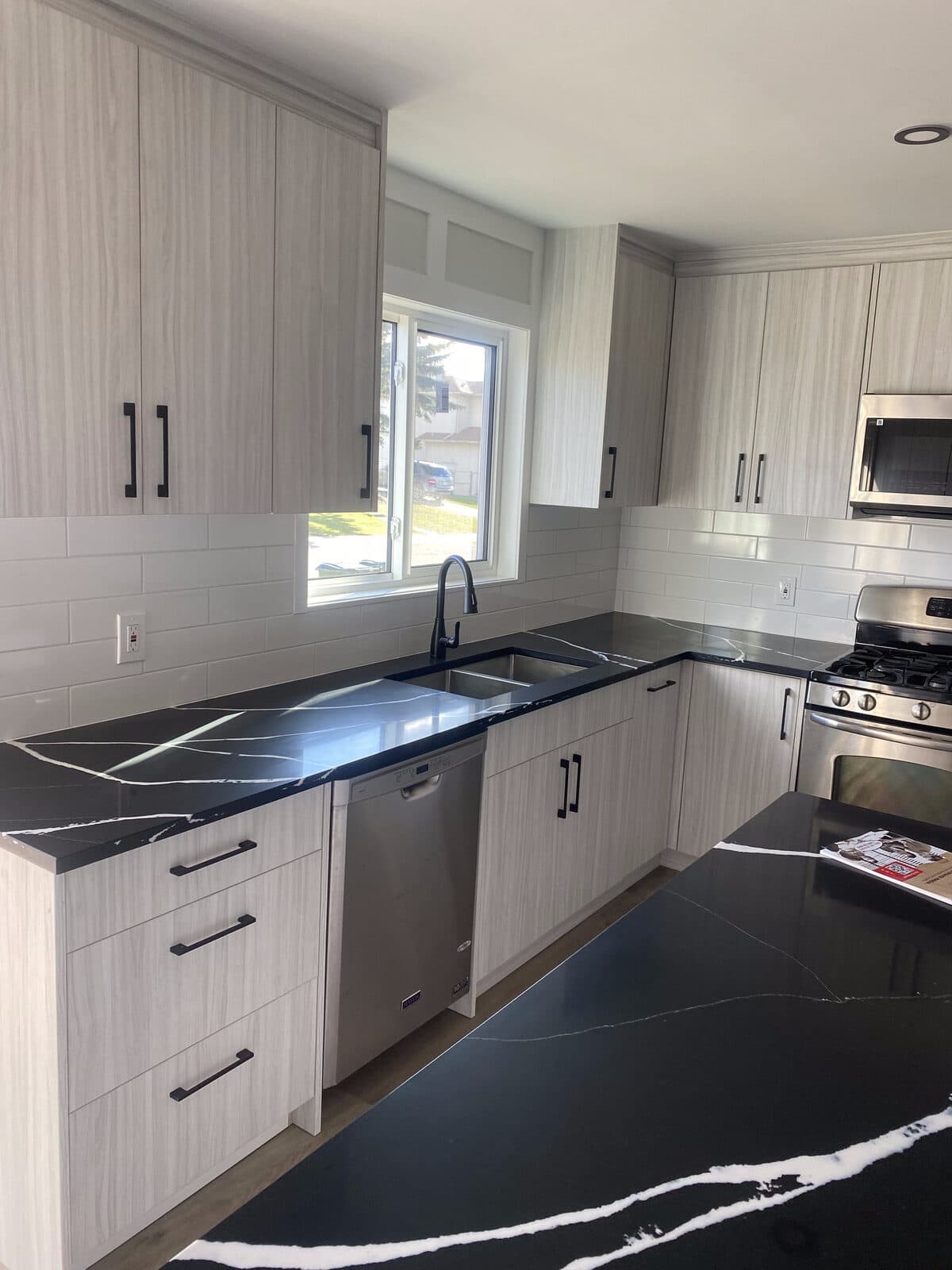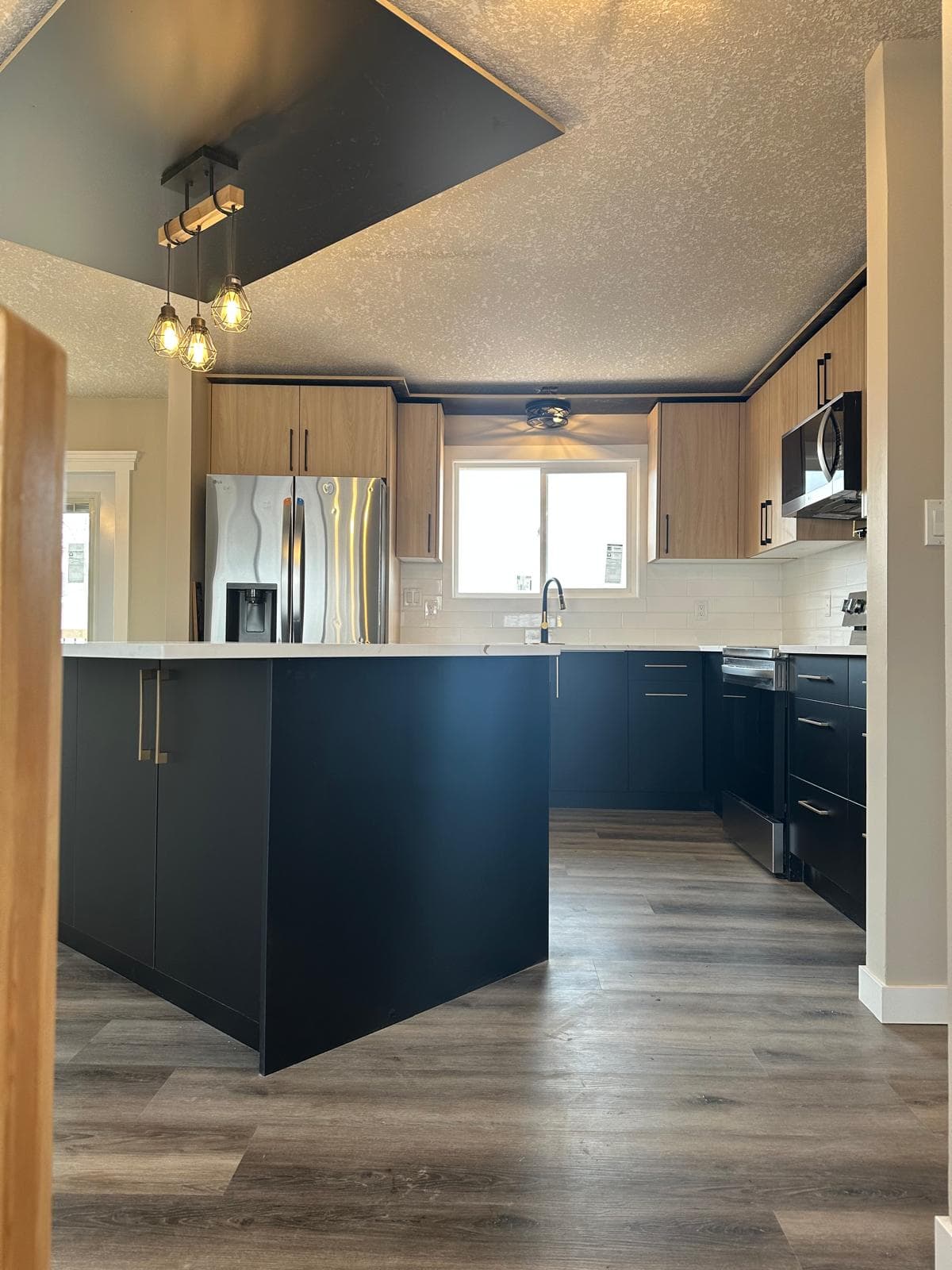
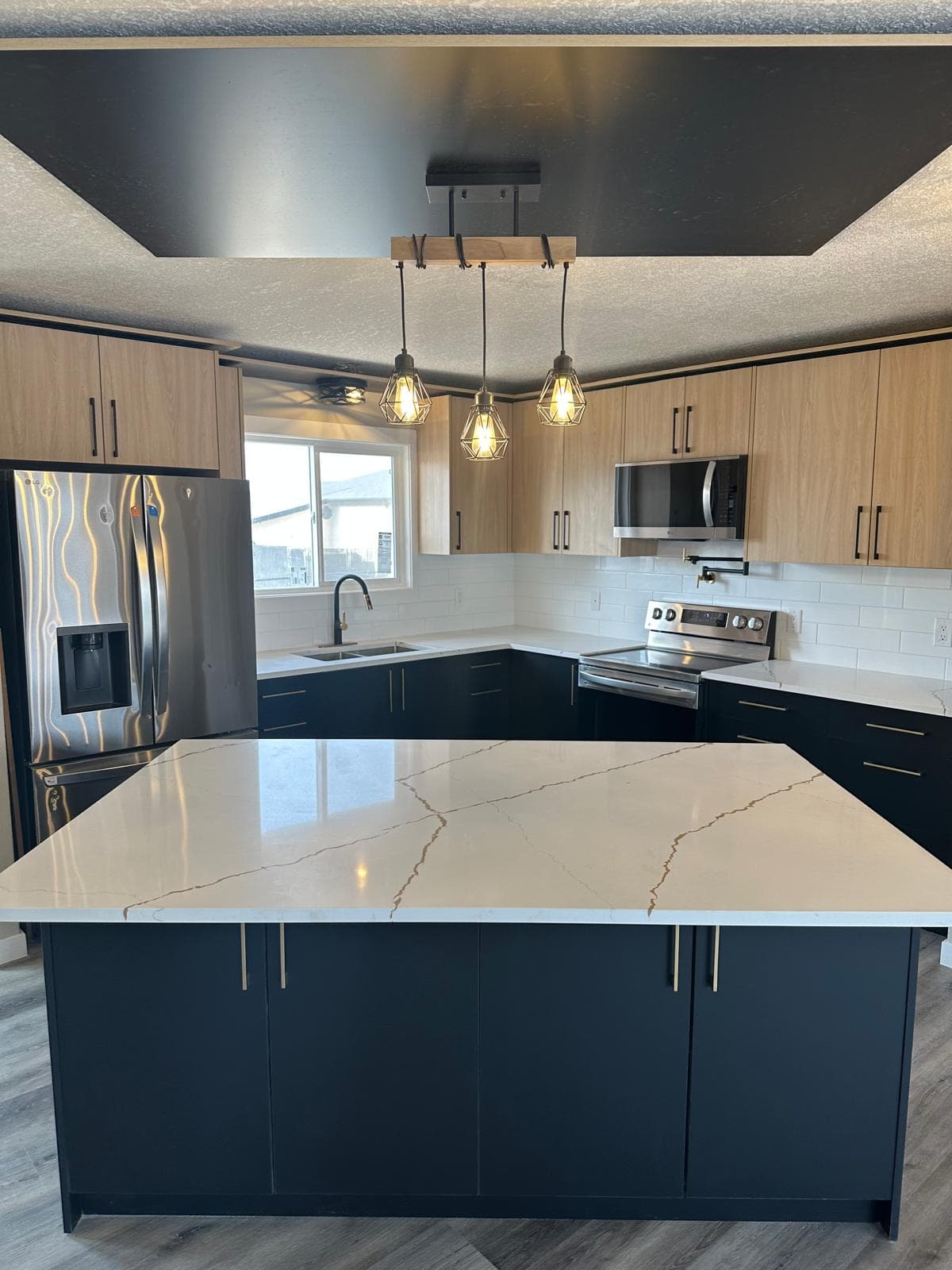
Project at a glance: a full kitchen renovation in Ponoka, Alberta. Two-tone cabinetry — matte black lowers paired with natural-wood uppers — a calacatta-style quartz waterfall island, custom black ceiling cove with cage-pendant cluster, brass pot filler, white subway tile backsplash, and luxury vinyl plank flooring throughout. This was a JFK Surfaces build, start to finish.
We’re writing this one up because it’s a good example of how a few specific design decisions — not just a bigger budget — turn a builder-grade kitchen into something that looks intentional. If you’re thinking about a kitchen renovation in Ponoka or anywhere in Central Alberta, this is the kind of conversation we have at the quote stage.
The brief
The homeowners wanted an open, modern kitchen that didn’t feel cold. They cooked together a lot and wanted a big island they could actually work around — not a token peninsula. They also wanted the space to feel grounded in natural materials, not all white and grey like every other reno on Pinterest.
The starting point was a closed-off layout with dated cabinets and laminate counters. We opened the workspace, reworked the lighting plan, and built a layout that put the island in the centre of the action.
The design decisions that did the heavy lifting
1. Two-tone cabinetry — black + natural wood
All-white kitchens are safe but they read identical. All-dark kitchens can feel heavy. Splitting the palette — black on the lowers, natural-wood-look uppers — gives the kitchen visual depth and lets the island take centre stage without competing with a wall of dark cabinets behind it. The wood-grain uppers warm the space and connect to the LVP floor.
2. Calacatta-style quartz waterfall island
The island is the moment in this kitchen. Calacatta-style quartz with dramatic gold and brown veining, full waterfall down both ends. Quartz is our usual recommendation in Central Alberta because it handles the freeze-thaw temperature swings inside homes here better than natural marble (which can be more sensitive to etching), and it doesn’t need annual sealing like granite. The bold veining gives you the marble look without the maintenance.
3. Custom black ceiling cove with cage pendants
The ceiling was the secret weapon. We framed a rectangular black cove directly over the island, mounted a wood beam under it, and hung three black cage pendants in a tight cluster. This does two things: it visually anchors the island in the room, and it adds a design feature without taking up floor or counter space. A flat stippled ceiling can carry a lot more interest than people think.
4. Brass faucet and pot filler
Brass — or champagne bronze, depending on the brand — against black cabinets is a combination that consistently looks premium. We installed a brass pull-down faucet at the prep sink and a wall-mounted brass pot filler behind the range. The pot filler is one of those upgrades that’s not strictly necessary, but anyone who actually cooks pasta or makes stock will use it every week.
Side view of the island showing the black waterfall end panel, brushed brass hardware, and LVP flooring continuity into the open kitchen.
5. White subway tile backsplash — full height
Subway tile is a workhorse: durable, easy to clean, never goes out of style. We ran it full-height behind the range and to the underside of the upper cabinets everywhere else. Crisp white tile against black cabinets keeps the space feeling bright and bounces light from the window above the sink.
6. Luxury vinyl plank flooring
LVP was the right call for this Ponoka home. It’s water-resistant (important in a kitchen), holds up to dropped pots and chairs being dragged across it, and the modern wood-look patterns are convincing. It also flows continuously into the adjacent rooms, which makes the open layout feel even bigger.
What we’d call out for anyone planning a similar kitchen in Central Alberta
- Plan the lighting before you frame. The ceiling cove only works because the electrical was roughed in before drywall went up. Trying to add a feature ceiling at the end is a much bigger job.
- Order the cabinets early. Two-tone semi-custom and custom cabinets often have 6–10 week lead times. We’ll usually order cabinetry the week the contract is signed so it’s on site when we’re ready to install.
- Pick the counter slab in person. Calacatta-style quartz veining varies a lot from slab to slab. We bring clients to the stone yard so they can choose the actual piece that will get cut for their island.
- Brass shows fingerprints — live with it. Brushed (not polished) brass is more forgiving day-to-day. Polished brass looks incredible in photos but needs more wiping.
- A pot filler needs a real water line. If your range wall is an exterior wall, plan for proper insulation around the line. Central Alberta winters will find any gap.
Why this kitchen works for Ponoka
Ponoka homes — especially in the newer subdivisions like Centennial and the established acreages out toward Wolf Creek — are increasingly catching up to the standards you see in Red Deer and Lacombe. A two-tone kitchen with a feature island isn’t just “looks good” — it’s genuinely a resale and lifestyle upgrade. Real-estate-wise, a well-executed modern kitchen tends to be the room buyers focus on most when comparing listings, and it’s the single biggest lever on perceived home value in this price band.
Practically, the materials we chose all hold up to Central Alberta living: quartz that doesn’t need annual sealing, LVP that shrugs off dropped cast iron and the salt that comes in on winter boots, full-height tile so the wall behind the range doesn’t need to be scrubbed every week.
What it actually involved
Without quoting numbers (every kitchen is different), the scope here covered: full cabinet teardown and disposal, plumbing and electrical rough-in for the new layout, framing for the ceiling cove, drywall and paint throughout the kitchen, cabinet installation, quartz countertop fabrication and waterfall install, tile backsplash, LVP flooring, brass plumbing fixtures, range hood and pot filler installation, appliance hookup, and a final detailed clean.
Permits in Ponoka are coordinated through the Town of Ponoka planning office. We pull the necessary trade permits (electrical, gas, plumbing) and coordinate inspections so the homeowner doesn’t have to. For a project this size, expect roughly 4–8 weeks of active work once materials are on site, plus the lead time for custom cabinetry up front.
Want a kitchen renovation in Ponoka?
We work all over Central Alberta from our home base in Innisfail — Ponoka is a 35-minute drive and we’ve done kitchens, basements, and additions across the area. If you’ve got a kitchen you’re tired of, the first step is a free walk-through so we can see the space and talk through what’s realistic for your home, layout, and timeline. Get in touch or call Fabien directly at (236) 880-3675.