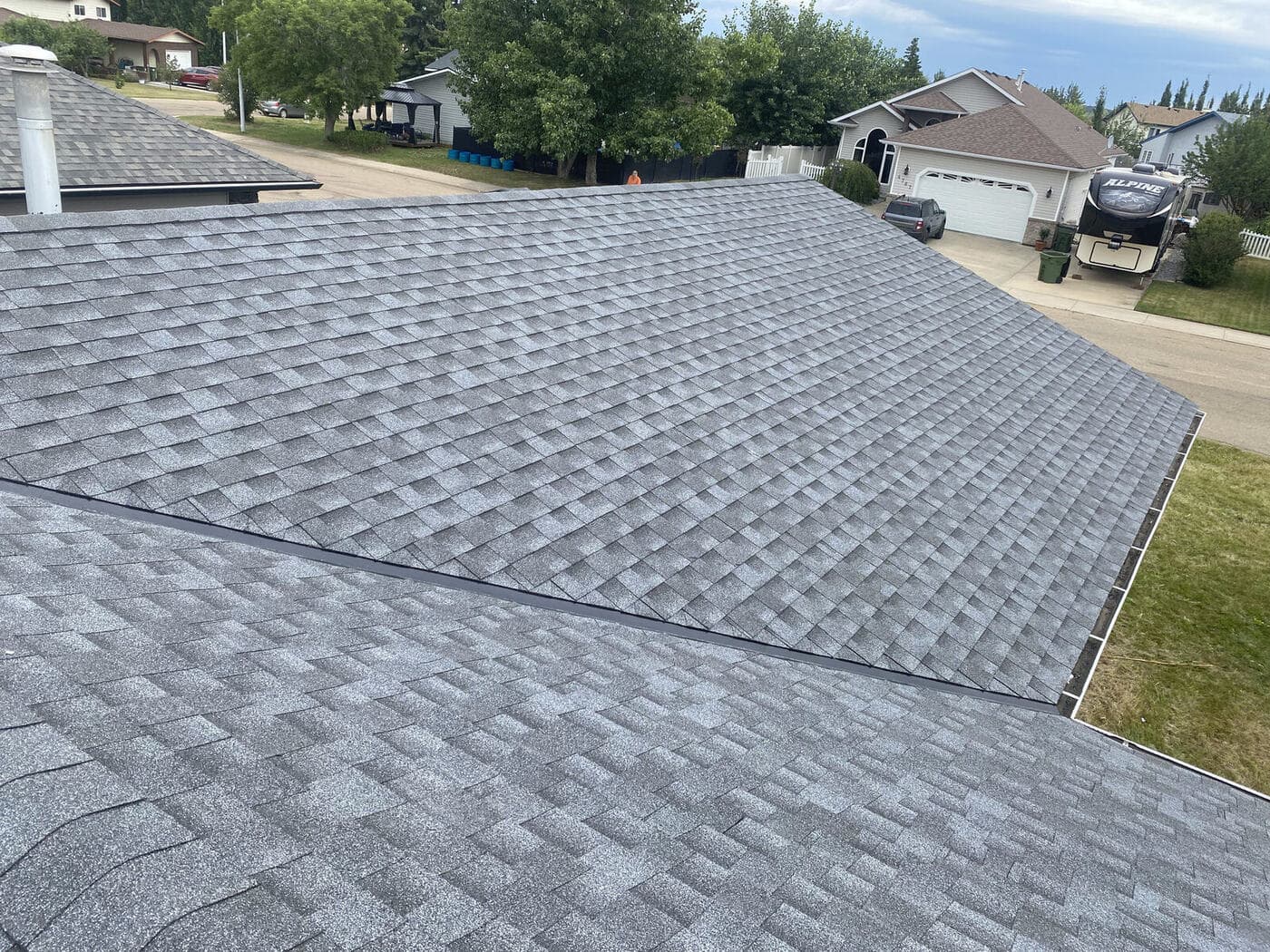
Short answer: most asphalt shingle roofs in Alberta last between 15 and 25 years, but our climate — hail, freeze-thaw, UV, high winds, big snow loads — can shorten that lifespan considerably. If your roof is showing several of the seven signs below, you're probably looking at a replacement rather than another round of repairs.
We can't tell you what your specific roof will cost — too many variables, and shingle prices move with the materials market — but we can help you figure out whether you're actually at the end of your roof's life or just dealing with a fixable issue. Here's how to read it.
How long Alberta roofs actually last
Across the industry, asphalt shingle roofs in Alberta last 15–25 years under normal conditions. That number is shorter on north-facing slopes that get a lot of ice damming, on poorly ventilated attics, on roofs that took a major hail hit, and on roofs that were installed cheap to begin with (thin underlayment, skimped flashing, no ice-and-water shield in valleys).
Metal roofs last considerably longer — 40+ years is realistic — and flat roofs (TPO, EPDM, modified bitumen) sit somewhere in the 20–30 year range depending on the system and the install.
A roof installed before 2005 is overdue for at least a serious inspection. A roof installed before 2000 is on borrowed time. That doesn't mean it's leaking yet — but it does mean a hail storm or a hard freeze-thaw season could push it over the edge fast.
The 7 signs your Alberta roof is done
1. Age — it's over 20 years old
The single biggest predictor. If you don't know exactly how old your roof is, check past inspection reports, your roofing warranty if you have one, or ask the previous owner. If you bought the house and have no idea, assume the worst. A roof that's already 20 years old is going to fail somewhere soon, even if nothing obvious is wrong yet.
2. Granule loss — those tiny stones in your eavestroughs
Asphalt shingles are coated with mineral granules that protect the underlying asphalt from UV degradation. As the shingles age, they shed those granules. You'll see them collecting in eavestroughs, in downspout splash zones, and along driveways below the roof.
Some granule loss in the first year or two is normal. Heavy ongoing loss after 10+ years means the asphalt is increasingly exposed, and the shingles are accelerating toward failure.
3. Curling, cupping, or clawing shingles
When you look at the roof, healthy shingles lie flat against the surface. Aged shingles start to do one of three things:
- Cupping — edges turn upward, making a shallow bowl
- Clawing — the middle of the shingle rises while edges stay down
- Curling — corners pull away from the roof entirely
All three mean the shingle's protective bond is compromised. Wind gets under them, water gets under them, and the next big storm tears them off entirely.
4. Missing, cracked, or broken shingles
A handful of missing shingles after a storm can be repaired. Many missing shingles, or shingles cracked all over the roof, is past the repair point. Patches on aged shingles also rarely blend visually with the original — and the underlying decking and underlayment may have taken water damage already.
Special note for southern Alberta: hail damage to shingles often shows as small dark dots where the granule mat was knocked off. Multiple hits across the roof means insurance claim territory.
5. Water stains on ceilings or walls
If you've got tea-coloured stains spreading across ceilings or down the inside of exterior walls, water is getting in somewhere. Sometimes the leak is just at a vent boot or a flashing detail and is fixable. Sometimes the underlayment is compromised across a whole roof plane and patching one leak just sends the water somewhere else next season.
Don't ignore interior water stains. If your roof is also showing any of the other signs on this list, the stain is probably the symptom of a roof that needs to be replaced rather than patched.
6. Sagging rooflines or soft spots
Look at the ridge line from the street. A straight, level ridge is a healthy roof. A noticeable sag — even a small one — usually means the decking or rafters are wet, rotted, or have lost structural integrity. That's not a shingle problem; that's a strip-and-replace problem, and possibly a partial deck replacement on top of it.
If you can walk on the roof safely, soft spots underfoot tell the same story — wet decking that needs to come off.
7. Hail damage
Alberta gets hammered by hailstorms. After any significant hail event, get up and look (or have someone get up and look). Things to spot:
- Dark spots where granules were knocked off impact points
- Cracks radiating from impact dents
- Dented metal flashing, vents, or eavestroughs (a tell-tale sign that the shingles took hits too)
- Bruising — visible from underneath if you can get into the attic with a flashlight
Hail damage is typically covered by home insurance — but you usually have a window of time to file the claim. Check your policy and call your insurance company directly. They're the source of truth on what's covered.
Repair vs. replace — how to decide
A few rules of thumb that hold up:
- Localized damage, young roof: repair. A few windblown shingles on a 7-year-old roof is straightforward to fix.
- Multiple signs, aged roof: replace. If you're seeing granule loss, curling, AND missing shingles on a 20-year-old roof, throwing money at patches is throwing money away.
- Frequent repairs every storm: replace. If you're getting up there twice a season, the roof is telling you it's done.
- Selling soon: depends. A buyer's inspector will catch what you've been ignoring. Sometimes it's cheaper to replace before listing; sometimes it's cheaper to credit at closing. Talk to your realtor about your specific market.
A note on door-knockers after storms
After every big Alberta hailstorm, you'll get knocks on the door from roofers offering “free inspections.” Some of them are legitimate. Some of them aren't. A few protective rules:
- Never sign anything on the doorstep, especially anything that signs over your insurance claim
- Get multiple quotes
- Check that any roofer is licensed in Alberta and carries WCB and liability insurance
- Look for online reviews from people in your area, not generic five-star testimonials
- A reputable company will give you the time to think it over
What we do when we come look
When you call us out to look at a roof, we'll:
- Walk the perimeter looking for granule loss, dropped shingles, damaged flashing
- Get up on the roof (weather permitting) for a closer look at shingle condition, valleys, ridge cap, vent boots, and flashing
- Check your attic if accessible — for water stains on decking, daylight where there shouldn't be any, and ventilation quality
- Tell you honestly what we see — including if we think it's a repair, not a replacement, even though we'd obviously rather quote the bigger job
- Give you a written estimate within a few days
If you're seeing any of these signs on a Central Alberta roof — Red Deer, Innisfail, Sylvan Lake, Lacombe, Penhold, Bowden, Olds, Blackfalds, or anywhere in between — we're happy to come take a look. See our roofing & exterior services or call us direct.